Rug Placement Guide for L-Shaped Sectional Sofas
Placing a rug under an L-shaped sectional sofa starts with getting the size right. A 9x12 rug works for most living rooms, with front legs of both sofa sections sitting on the rug. Align the rug with the sofa, not the wall. Wool area rugs in neutral or earth tones work best under large sectionals.
Your sofa arrived. You arranged it into that perfect L-shape. The room looked great for about five minutes. Then you realized the floor underneath looked completely bare. Suddenly, nothing felt quite right.
That’s the L-shaped sectional problem nobody talks about. These sofas are generous, dramatic, and a little awkward to style around. They take up more visual space than a standard sofa. They angle into corners. And the rug beneath them has to work harder than it would under any other piece of furniture.
The good news? Once you understand how living room rug placement works specifically for an L-shape, everything clicks.
Why L-Shaped Sectionals Need a Different Approach
Most rug placement advice assumes a straight sofa against a wall. You center the rug, let the front legs sit on it, and move on.
An L-shaped sectional breaks that logic. It has two arms extending in different directions. It creates an interior corner. And it usually anchors a larger section of the room than a regular sofa does.
Getting rug placement in the living room wrong with this setup means one of two things: a rug that looks too small and gets visually swallowed by the sofa, or a rug placed off-center that makes the whole seating area feel lopsided. Neither is what you want.
The Rule That Makes Everything Easier
Before you think about size or style, think about function. The rug’s job under an L-shaped sectional is to define the seating zone. It should pull the sofa, the coffee table, and any accent chairs into one clear, cohesive space.
When you look at the room, the rug should feel like the foundation everything is sitting on. Not a mat tucked under the sofa. A foundation.
Keep this in mind, and most placement decisions become much easier.
Three Placement Approaches That Actually Work
All legs on the rug
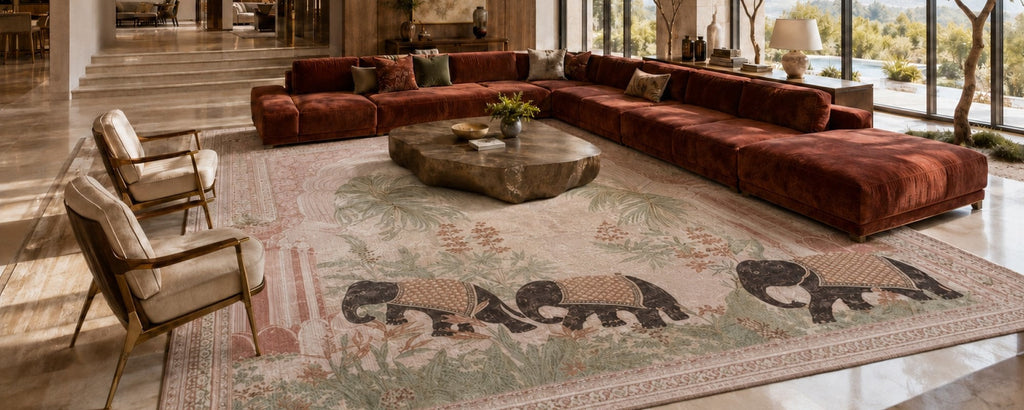
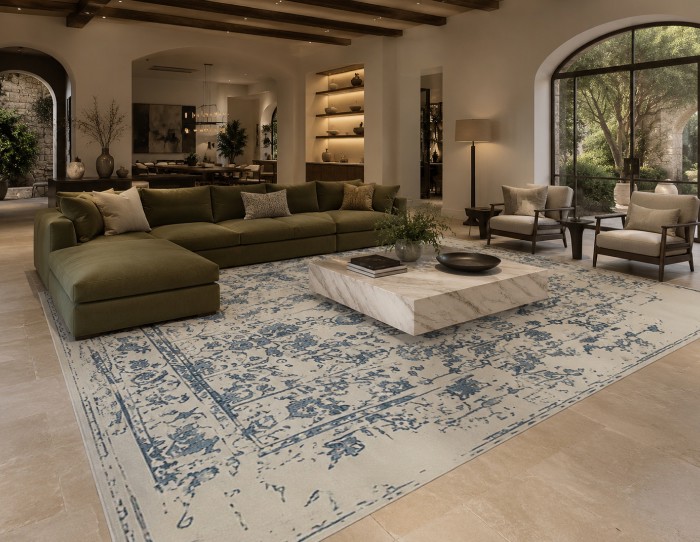
This is the cleanest option when you have the space. The entire sectional, including all legs, sits on the rug. The coffee table sits on it too.
For this to work, the rug needs to extend at least 18 inches beyond each visible edge of the sofa. That usually means a 9x12 or a 10x14 ft rug. If your room allows it, this approach always looks the most intentional.
Front legs on, back legs off
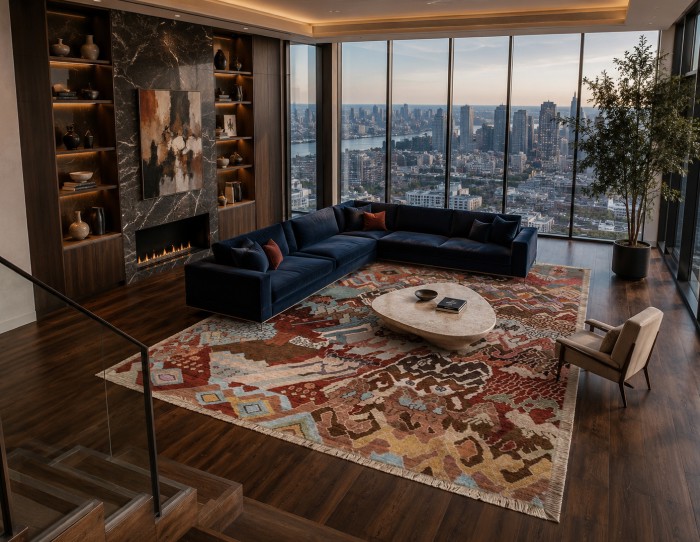
This is the most common approach for rooms that can’t fit an oversized rug. The front two legs of each sofa section sit on the rug. The back legs stay on the floor.
It still creates a unified seating area. And it works with a slightly smaller rug, typically an 8x10. The key is consistency. Both sections of the L need to follow the same rule. If one section has its front legs on and the other is floating off the rug, the placement looks accidental.
Rug under the coffee table only
This works in very large, open-plan rooms where the sectional divides a space rather than anchors one. In a standard living room, it tends to make the sofa look disconnected. Use this approach carefully.
Sectional Rug Placement: The Corner Question
The trickiest part of rug and sectional placement is handling the interior corner where the two sofa sections meet.
The corner of the sofa should sit comfortably within the rug’s area. It shouldn’t hang off the edge. And it shouldn’t be the reason you’ve pushed the rug too far to one side, leaving the other section floating.
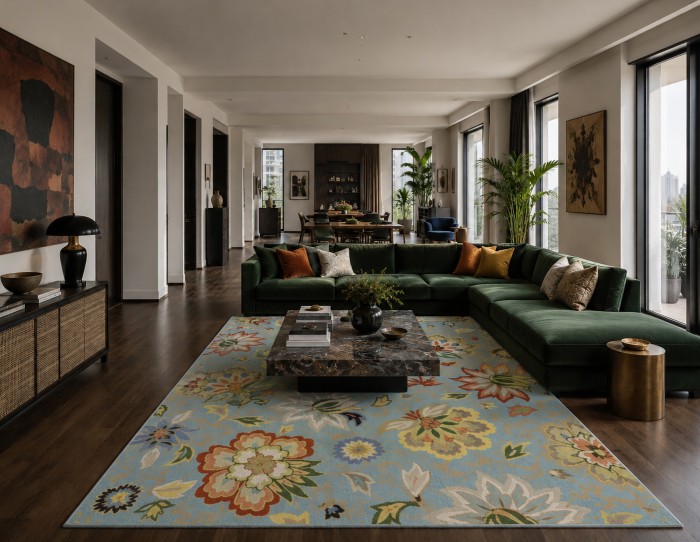
If you can’t center the rug under both sections of the L, the rug is probably too small—size up before trying to fix it with placement.
What Size Rug Works Best?
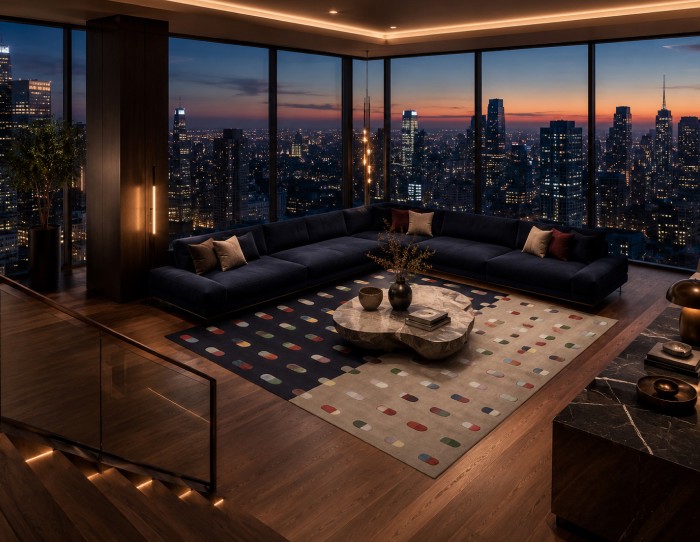
For most L-shaped sectionals in a standard living room, a 9x12 rug is the sweet spot. It’s large enough to anchor both sofa sections and the coffee table, with enough floor showing around the edges.
In a smaller room, an 8x10 rug works with the front-legs-on approach. In a larger space, go up to a 10x14.
A quick test before you buy: lay out painter’s tape on the floor in the dimensions you’re considering. Live with it for a day. You’ll know fast if the size feels right.
Don’t Forget the Chaise
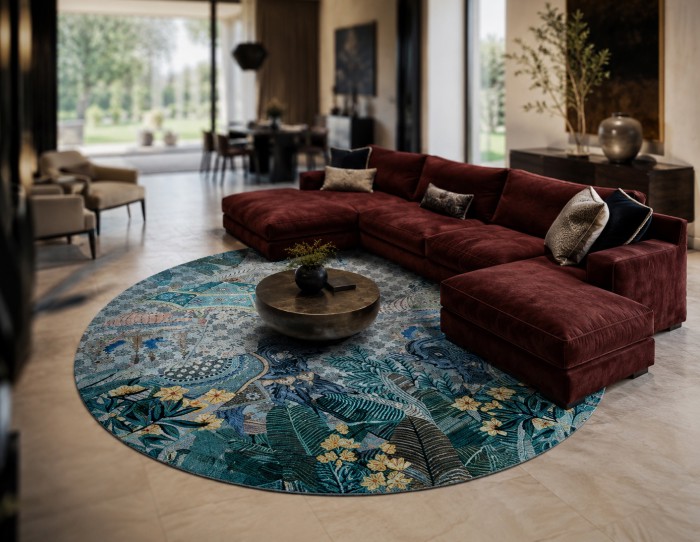
If your sectional has a chaise, it needs extra attention. The chaise typically extends further into the room than the main sofa section. If the rug doesn’t reach it, the sofa looks like it’s spilling off the edge.
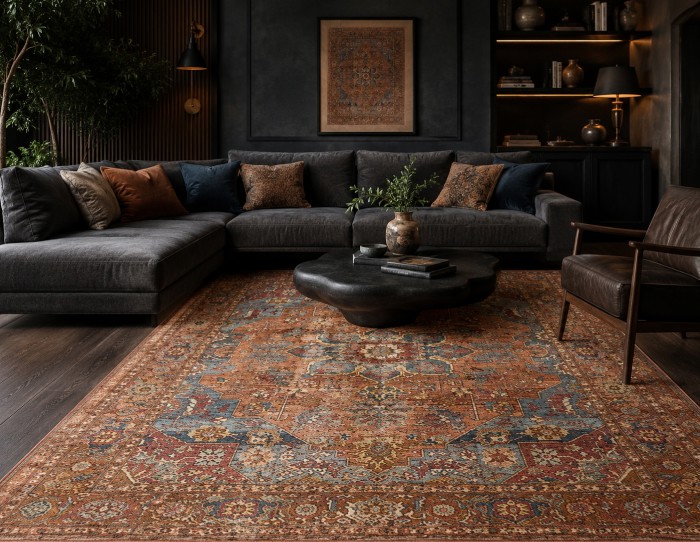
The chaise end should sit on the rug, or at least have its front edge touching it. A lot of people size their rug based on the main sofa section and forget the chaise entirely.
That’s usually why rug placement under the sectional ends up looking off even when the dimensions seem right.
Choosing the Right Rug for an L-Shaped Sectional
Placement is half the battle. What you place matters just as much.
For a sectional that gets daily use, a wool area rug is worth serious consideration. Wool handles foot traffic well, doesn’t flatten over time, and feels noticeably better underfoot than synthetic alternatives. It’s the kind of material that gets better with age rather than worse.
In terms of style, modern rugs with low-profile flat weaves tend to work well under large sectionals. They don’t compete visually with the sofa’s volume. An abstract rug with an open, organic pattern adds texture without making the space feel cluttered.
If your sectional is in a neutral tone, earth tone rugs are a natural fit. Warm terracottas, sandy tones, and muted olives ground the space without fighting the sofa for attention.